
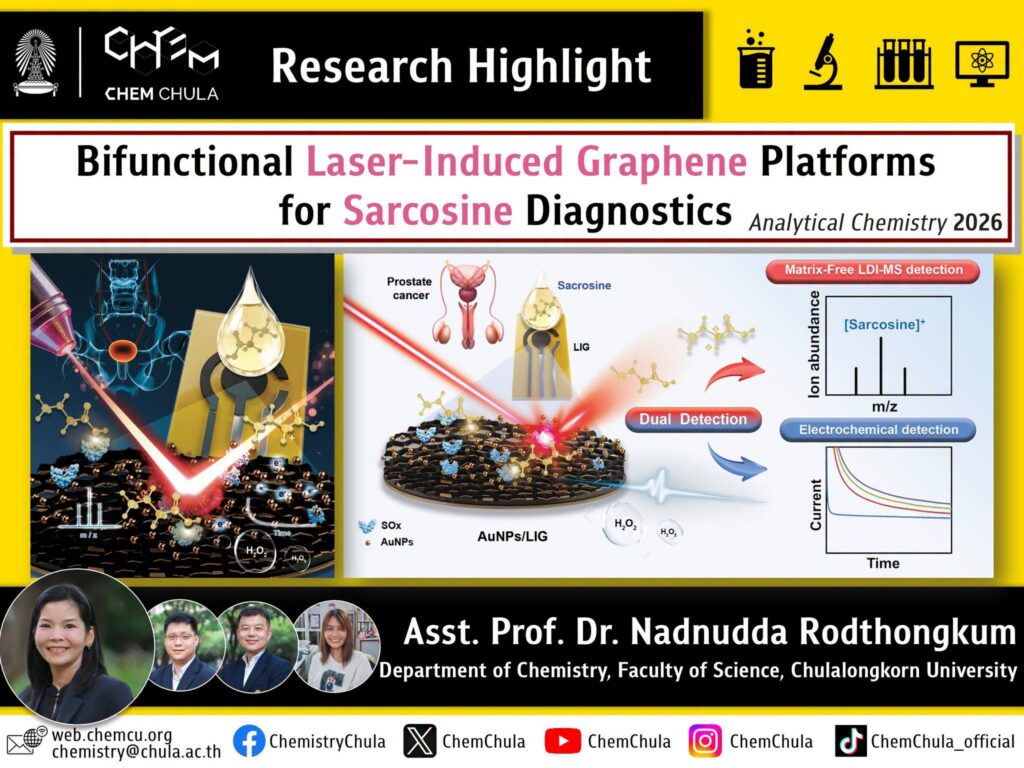
Prostate cancer is one of the most common cancers among men, making early detection critically important. One promising biomarker is sarcosine, which can be detected in urine and may help indicate the risk of prostate cancer. In this work, Asst. Prof. Nadnudda Rodthongkum’s group developed a Laser-Induced Graphene (LIG) platform that serves two analytical functions on a single chip (a dual-modality platform).
⚡ Mode 1: Electrochemical Sensor: By integrating gold nanoparticles (AuNPs) with the enzyme sarcosine oxidase, the platform enables rapid electrochemical screening of sarcosine with a detection limit as low as 2 μM.
🧪 Mode 2: Laser Desorption Ionization Mass Spectrometry: The same LIG chip can then be directly used for mass spectrometric confirmation without requiring a conventional organic matrix, achieving an even higher sensitivity with a detection limit of 500 nM.
Key highlights of this work include:
✅ Minimal sample preparation using urine samples.
✅ Integration of rapid screening and confirmatory analysis on a single platform.
✅ Combining the complementary strengths of electrochemical sensing and mass spectrometry.
✅ Demonstrating that Laser-Induced Graphene is not only an excellent electrochemical electrode but also an effective substrate for matrix-free mass spectrometry.
This research has been published in Analytical Chemistry, with a collaborative effort between researchers from the Department of Chemistry, Faculty of Science, Chulalongkorn University, and our international collaborators. We hope this work represents another step toward the development of rapid, accurate, and practical diagnostic technologies for future clinical applications.
- Wimala Karintrithip
- Pumidech Puthongkham
- Pranee Rattanawaleedirojn
- Narong Praphairaksit
- Richard W. Vachet
- Andrew J. DeMello
- Nadnudda Rodthongkum