
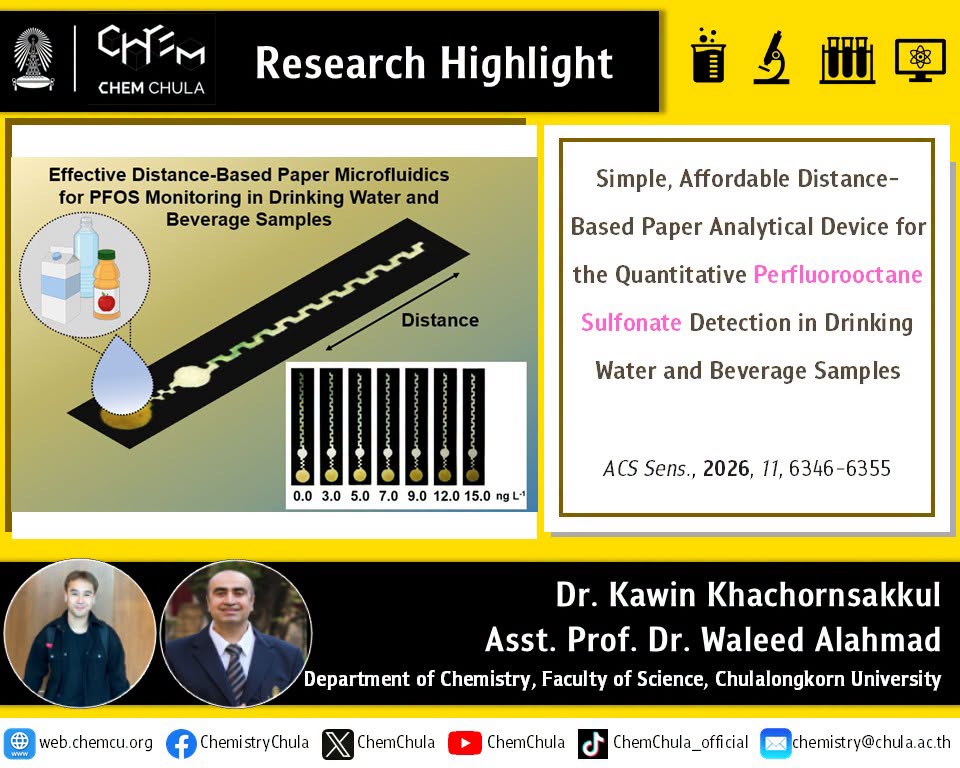
This research, led by Dr. Kawin Khachornsakkul and Assistant Professor Dr. Waleed Alahmad, presents the first demonstration of a distance-based paper analytical device for the highly sensitive detection of perfluorooctane sulfonate (PFOS) in drinking water and beverages. The platform integrates microfluidic technology, nanomaterials, and chemical sensing, enabling rapid visual readout with a detection limit as low as 3.0 ng/L.
The developed device provides accurate and reliable PFOS quantification, with results comparable to those obtained using advanced instrumental analytical methods. It requires neither sample preparation nor preconcentration and eliminates the need for expensive instrumentation, making it well suited for rapid on-site analysis by non-specialists. This sensor therefore has strong potential as a simple, low-cost, and highly sensitive analytical tool for the rapid assessment of PFOS contamination in water and food samples.
- Kawin Khachornsakkul
- Tapparath Leelasattarathkul
- Waleed Alahmad