
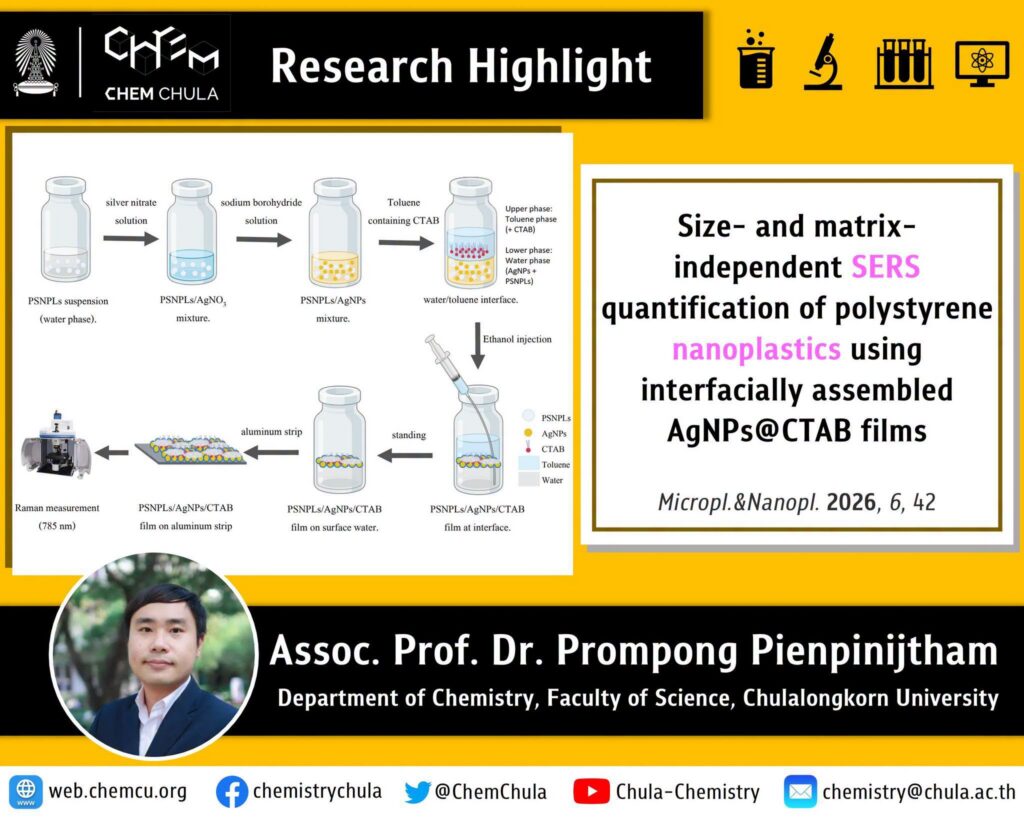
Nanoplastics are extremely small plastic particles, hundreds of times smaller than the diameter of a human hair. They are considered an emerging contaminant that can pollute natural water sources. Detecting particles at this scale remains a major analytical challenge because of their tiny size, low concentrations, and interference from other substances present in water.
This research developed a highly sensitive platform for detecting polystyrene nanoplastics using Surface-Enhanced Raman Scattering (SERS) combined with a self-assembled silver nanoparticle film formed at the water–toluene interface. The platform demonstrated high sensitivity in detecting nanoplastics across a particle size range of 29–100 nm and performed effectively in various water matrices, including tap water, drinking water, river water, seawater, and artificial seawater.
This paves the way for the development of rapid, reliable analytical tools for monitoring nanoscale plastic pollution in the environment, providing a promising approach for future water quality monitoring and environmental assessment.
- Pattamon Janproy
- Boonphop Chaisrikhwun
- Prompong Pienpinijtham